
Platelet-Rich Plasma (PRP) treatment has become a popular option for people looking for minimally invasive approaches to hair restoration, skin rejuvenation, and certain regenerative treatments. One reason for its popularity is that PRP uses components taken from your own blood rather than relying on a completely synthetic material.
But what exactly are the PRP treatment benefits, and is PRP suitable for everyone?
In this guide, we’ll explain how PRP works, its potential benefits, the treatment process, possible side effects, and what you should consider before choosing treatment. If you are considering PRP, a professional consultation with Dr. Shays can help you understand whether this approach fits your individual goals and needs.
What Is PRP Treatment?
PRP stands for Platelet-Rich Plasma. During the procedure, a small sample of your blood is collected and processed to separate the platelet-rich plasma from other blood components.
Platelets contain growth factors and other biological substances involved in the body’s natural healing processes. The concentrated plasma can then be applied or injected into a targeted treatment area, depending on the purpose of the procedure.
PRP is commonly discussed in connection with:
- Hair thinning and hair restoration
- Skin rejuvenation
- Acne scar improvement
- Collagen stimulation
- Certain tendon, joint, and soft-tissue applications
The exact use of PRP depends on the patient’s condition, treatment goals, and medical assessment.
How Does PRP Treatment Work?
The PRP process usually involves several straightforward steps.
1. Consultation
The first step is a medical consultation. Your provider reviews your concerns, medical history, current treatments, and goals to determine whether PRP may be appropriate.
2. Blood Collection
A small amount of blood is taken, usually from the arm. This is similar to a routine blood draw.
3. Platelet Separation
The blood sample is placed into a centrifuge. The centrifuge separates different components of the blood and allows the platelet-rich plasma to be prepared.
4. PRP Application
The prepared PRP is delivered to the treatment area. Depending on the application, this may involve injections or techniques such as microneedling.
5. Natural Healing Process
After treatment, the growth factors in the PRP may support the body’s natural repair and regeneration processes. Results do not usually appear instantly and can develop gradually over time.
Key PRP Treatment Benefits
There are several reasons people consider PRP treatment. However, the benefits depend on the treatment area, underlying condition, individual health, and treatment plan.
1. Uses Your Own Blood
One of the most notable PRP treatment benefits is that the material comes from your own blood.
Because PRP is autologous, it does not introduce a completely foreign biological material into the treatment area. This can make PRP an appealing option for people looking for treatments that use their body’s own biological components.
2. Supports Natural Regeneration
PRP contains concentrated platelets and growth factors that are involved in tissue repair.
When PRP is delivered to an appropriate treatment area, it may support natural healing and regeneration. This is one reason PRP has applications across aesthetic and regenerative medicine.
3. May Support Hair Growth
PRP is commonly used as part of treatment plans for certain types of hair thinning.
Research and clinical use suggest that PRP may help support hair follicle health and improve hair density in some patients, particularly when used for appropriate types of hair loss. However, PRP is not a guaranteed cure for every cause of hair loss.
A professional evaluation is important before starting treatment because hair loss can have many different causes.
4. May Improve Skin Quality
Another potential benefit of PRP is its use in skin rejuvenation.
PRP may support collagen production and tissue regeneration, which can contribute to improvements in skin texture, elasticity, and overall appearance.
It may be considered for concerns such as:
- Fine lines
- Uneven skin texture
- Dull-looking skin
- Certain acne scars
- Early signs of skin aging
Individual results can vary, so realistic expectations are important.
5. Minimally Invasive Approach
Unlike surgical procedures, PRP treatment generally involves a blood draw and injections or another minimally invasive method of delivering the prepared plasma.
This can make it attractive to people who prefer a non-surgical approach. However, minimally invasive does not mean completely risk-free.
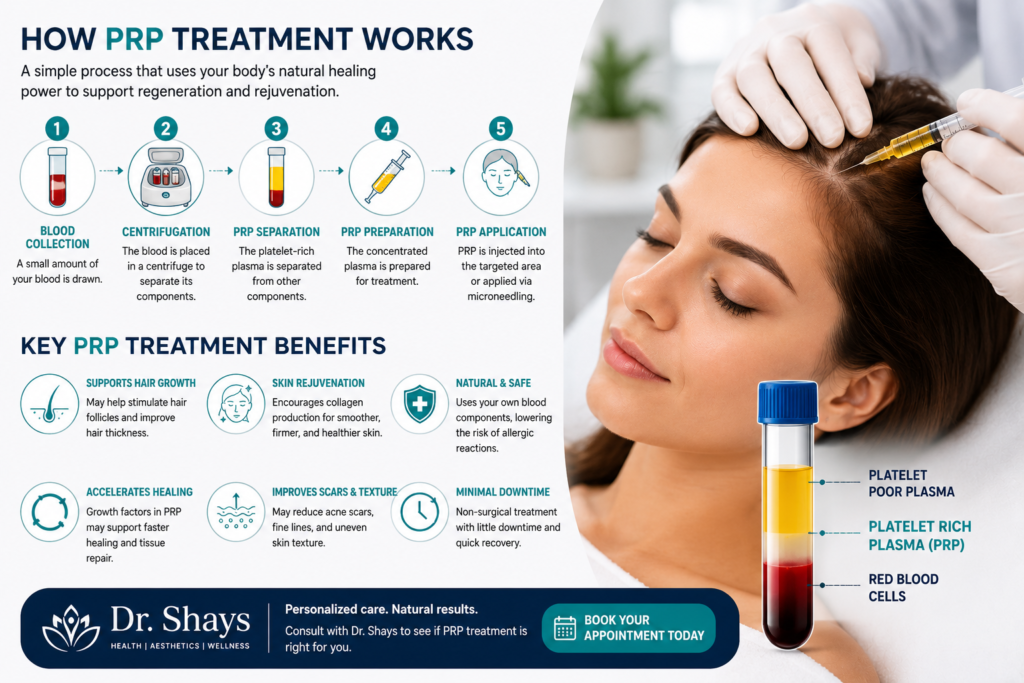
6. Usually Requires Limited Recovery
Many people appreciate PRP because recovery is generally shorter than with more invasive procedures.
Some patients may experience temporary redness, swelling, bruising, tenderness, or discomfort around the treatment area. These effects typically improve as the area heals.
7. Can Be Part of a Personalized Treatment Plan
PRP does not have to be considered as a one-size-fits-all treatment.
A healthcare professional can evaluate your specific concern and determine whether PRP makes sense on its own or as part of a broader treatment plan.
This personalized approach is particularly important for hair loss and skin concerns because different conditions require different treatments.
PRP Treatment for Hair
Hair thinning can affect both men and women. PRP is often considered for certain types of hair loss because it may support the health and activity of existing hair follicles.
Potential goals of hair PRP treatment can include:
- Supporting hair follicle health
- Reducing hair shedding in appropriate patients
- Improving hair density
- Supporting healthier-looking hair
- Complementing other hair restoration approaches
However, PRP is not suitable for every type or stage of hair loss. A medical evaluation can help identify the underlying cause before treatment begins.
PRP Treatment for Skin Rejuvenation
PRP is also used in aesthetic medicine to support skin rejuvenation.
The treatment may be considered for people who want to improve:
- Skin texture
- Skin elasticity
- Fine lines
- Acne scars
- Overall skin appearance
Because collagen remodeling takes time, improvements may develop gradually rather than immediately.
For people considering PRP for cosmetic purposes, the goal should be natural-looking improvement rather than unrealistic overnight results.
Is PRP Treatment Safe?
PRP is generally considered a minimally invasive procedure, but every medical treatment carries potential risks.
Because PRP is prepared from your own blood, allergic reactions to the plasma itself are less of a concern than with some foreign materials. However, patients can still experience temporary discomfort, swelling, redness, or bruising. Rare complications can also occur.
Your provider should review your medical history and determine whether PRP is appropriate for you before treatment.
What Should You Expect After PRP Treatment?
Recovery depends on the treatment area and the individual.
You may experience mild:
- Redness
- Swelling
- Tenderness
- Bruising
- Soreness
Your provider may also recommend specific aftercare instructions. Following those instructions can help support proper recovery.
Most importantly, do not judge the treatment too quickly. PRP works through biological processes that can take time, and results differ between patients.
Who May Be a Candidate for PRP?
PRP may be worth discussing with a qualified healthcare professional if you are interested in:
- Hair restoration
- Improving certain types of hair thinning
- Skin rejuvenation
- Improving skin texture
- Supporting collagen production
- A minimally invasive treatment option
However, suitability depends on your health, medical history, medications, the condition being treated, and your expectations.
A consultation should always come before deciding whether PRP is right for you.
Why Consider Dr. Shays for Your PRP Consultation?
Choosing the right healthcare provider is an important part of any treatment decision.
At Dr. Shays, the focus should be on understanding your individual concerns and helping you make an informed decision about your healthcare options. Instead of assuming that PRP is right for everyone, a personalized consultation can help determine whether it fits your specific goals.
If you are considering PRP for hair, skin, or another appropriate concern, discuss your expectations and medical history with the Dr. Shays team before beginning treatment.
Ready to explore your options? Book an appointment with Dr. Shays to discuss whether PRP may be appropriate for your needs.
PRP Treatment Benefits vs. Traditional Options
| Feature | PRP Treatment | Other Treatment Options |
|---|---|---|
| Uses your own blood components | Yes | Depends on treatment |
| Surgical procedure | No | Some options require surgery |
| Recovery | Usually limited | Depends on procedure |
| Treatment purpose | Hair, skin, and selected regenerative uses | Depends on treatment |
| Results | Can develop gradually | Varies |
| Personalized approach | Yes | Depends on provider |
The best option depends on your condition, treatment goals, medical history, and professional assessment.
Final Thoughts on PRP Treatment Benefits
The potential PRP treatment benefits make PRP an interesting option for people seeking minimally invasive approaches to hair restoration, skin rejuvenation, and selected regenerative applications.
PRP uses your own blood components and may support natural healing processes, collagen production, and hair follicle health in appropriate patients. However, results are not guaranteed, and PRP is not suitable for every person or every condition.
If you are thinking about PRP treatment, start with a professional consultation rather than choosing a procedure based only on online information.
Dr. Shays can help you discuss your concerns, understand your options, and determine whether PRP is worth considering for your individual goals. Book your appointment today.
Frequently Asked Questions About PRP Treatment Benefits
1. What are the main PRP treatment benefits?
Potential benefits include supporting natural tissue regeneration, improving certain aspects of skin quality, supporting hair follicle health, and providing a minimally invasive treatment option.
2. Does PRP treatment help with hair loss?
PRP may support hair growth and density in some patients with appropriate types of hair loss. However, results vary, and a medical assessment is important to identify the cause of hair loss.
3. Can PRP improve skin?
PRP may support collagen production and improve aspects of skin texture, elasticity, and appearance. Results develop gradually and vary between individuals.
4. Is PRP treatment painful?
Some patients experience mild discomfort during injections. Temporary soreness, redness, swelling, or bruising may occur afterward.
5. How long does it take to see PRP results?
Results depend on the treatment area and individual response. Some improvements may take several weeks or longer to become noticeable, while additional changes can develop over subsequent months.
6. Is PRP suitable for everyone?
No. PRP is not appropriate for everyone or every condition. A healthcare professional should review your medical history and treatment goals before recommending PRP.
7. Why should I consult Dr. Shays about PRP?
A consultation with Dr. Shays can help you understand whether PRP is appropriate for your individual concerns and what treatment options may best fit your goals.
Book an Appointment with Dr. Shays today to discuss your PRP treatment options.expertise, advanced treatments, and compassionate approach you deserve. Schedule your consultation today and discover how a beautiful smile can change your life.